
Dodge ETC Warning Light (the Lightning Bolt)
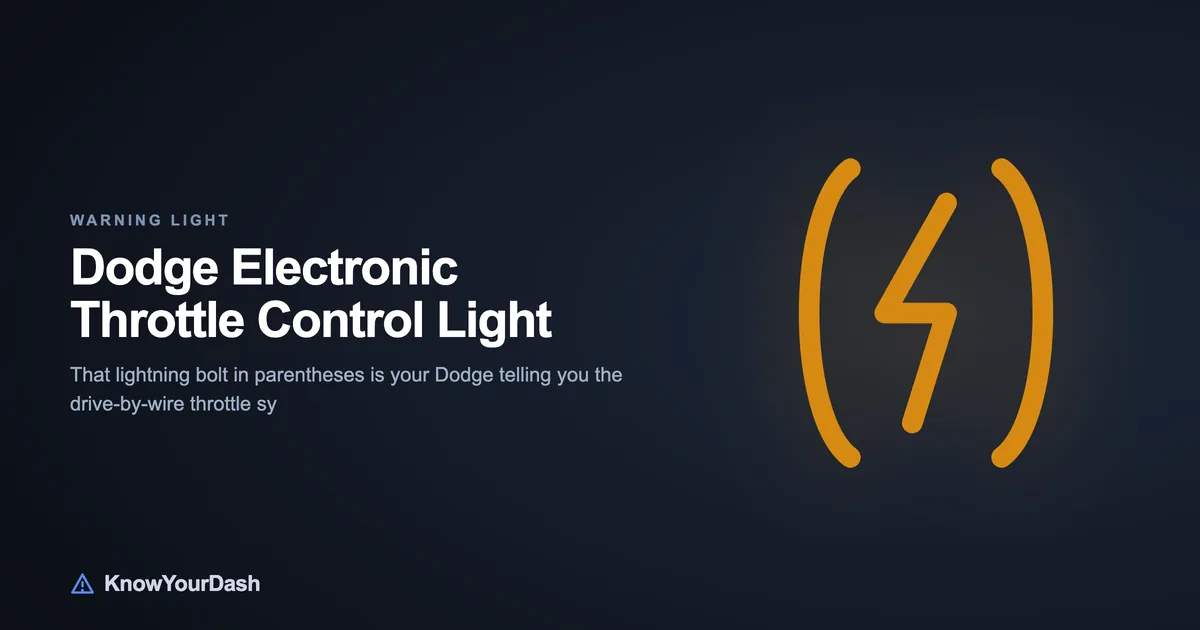
The Electronic Throttle Control (ETC) warning light on Dodge, Chrysler, Jeep, and Ram vehicles looks like a lightning bolt inside two curved brackets. When it turns on, the powertrain control module has detected a fault somewhere in the drive-by-wire throttle chain - the sensors, wiring, throttle body, or the accelerator pedal position sensor itself.
A steady light means the system logged a fault but the car may still drive normally. A flashing light is more urgent: the system is actively struggling, and you will likely feel reduced power or the vehicle dropping into limp mode. Either way, the fix starts with an OBD-II scan to read the stored codes.
What the ETC light actually monitors
Traditional throttle systems used a cable running from the gas pedal to the throttle plate. Drive-by-wire replaces that cable with electronics: you press the pedal, an accelerator pedal position (APP) sensor sends a signal to the PCM, and the PCM tells an electric motor inside the throttle body to open the plate. Two separate throttle position sensors (TPS A and TPS B) inside the throttle body monitor the plate angle and cross-check each other.
The ETC light turns on when any link in this chain sends a reading that does not match what the PCM expects - a sensor voltage that is too high, too low, or mismatched between the two TPS circuits.
Electronic Throttle Control (ETC)
The PCM has detected a fault in the drive-by-wire throttle system - sensor mismatch, wiring problem, or throttle body issue.
What to do: Scan for codes immediately. Drive to a shop if the light is steady; pull over safely if it is flashing or power drops.
Common causes and their codes
Throttle body carbon buildup or failure (P2101, P2110). The electric motor inside the throttle body drives the throttle plate. Carbon deposits can stiffen the plate or coat the internal contacts, causing erratic readings. Cleaning the throttle body with throttle body cleaner is the first thing to try - remove the air intake hose, spray both sides of the plate, work it open and closed by hand, and reinstall. If the body is worn or the motor is dead, replacement is the next step (typically $150-350 for the part).
TPS voltage mismatch (P2135). The two internal TPS circuits are supposed to stay in a fixed ratio. If one drifts - often because of heat, vibration, or carbon on the contacts - the PCM flags a correlation fault and may trigger limp mode. On many Ram and Challenger owners' forum threads, a fresh throttle body cured P2135 when cleaning alone did not hold.
Accelerator pedal position (APP) sensor failure (P0221, P0223). The APP sensor sits on the pedal assembly under the dash. It also runs two circuits that the PCM cross-checks. Dirt ingestion or moisture in the connector is a common culprit. Try cleaning the connector with electrical contact cleaner and applying dielectric grease before replacing the whole pedal assembly ($80-180 for the part).
Wiring and connector faults. Mechanics on these platforms flag the harness connectors at the throttle body and pedal assembly as frequent failure points - especially on higher-mileage trucks. Corroded pins or a chafed wire can look identical to a dead sensor on a scan. Wiggling the connector while watching live data on a scan tool will often expose an intermittent fault instantly.
Reduced Power / Limp Mode
The PCM has restricted engine output to protect the drivetrain after an ETC fault. Speed may be limited to around 30 mph.
What to do: Drive slowly to a safe stop. Turn the engine off, wait 30 seconds, and restart - limp mode sometimes clears on restart. Get the codes read before driving further.
Check Engine (MIL)
A DTC has been stored in the PCM - on ETC faults, common codes include P2135, P2101, P0221, and P2110.
What to do: Read the codes with an OBD-II scanner. The specific code points to the circuit or component to inspect first.
Step-by-step diagnosis
1. Scan for codes. Any OBD-II scanner will pull the codes. Note every code present - multiple codes together tell a clearer story. P2135 with P2101 together strongly suggests the throttle body itself.
2. Inspect the connectors. Unplug the throttle body connector and the APP sensor connector under the dash. Look for green corrosion, bent pins, or moisture. Clean with electrical contact cleaner and apply a thin coat of dielectric grease before reconnecting.
3. Clean the throttle body. Spray throttle body cleaner on both sides of the plate with the engine off. Use a soft cloth or cotton swab around the bore. Many owners have resolved P2135 with cleaning alone.
4. Clear the codes and test-drive. After cleaning and reconnecting, clear the codes and drive normally. If the light stays off, cleaning fixed it. If it returns within a day or two, the part is worn and needs replacement.
5. Replace the offending part. If codes point to the throttle body (P2101, P2110, P2135 post-cleaning), replace the throttle body. If codes point to the APP sensor (P0221, P0223), replace the pedal assembly. Avoid replacing both at once - diagnose which circuit is actually out of range in live data.
A note on PCM replacement: the PCM rarely causes ETC faults on its own. Before authorizing a PCM swap, make sure the wiring harness and connectors have been thoroughly inspected.
Common questions
Can I drive with the ETC light on?
If the light is steady and the car drives normally, you can make a short trip to get the codes read - but avoid long highway drives. If the light is flashing, or if you feel reduced power or unresponsive acceleration, pull over safely and call for a tow or get the codes read before driving further. Continuing to drive in limp mode can cause additional fault codes to pile up.
Will the ETC light go off on its own?
Sometimes. An intermittent fault - like a loose connector or brief sensor glitch - can set the light and then clear itself after the engine is restarted. But the code stays stored in the PCM. If the root cause is not fixed, the light will return. Do not ignore it just because it went out.
What is the most common fix on a Dodge Ram?
On Ram 1500 and 2500 trucks, the throttle body is the most commonly replaced part for ETC faults. Cleaning it first costs nothing and fixes a meaningful number of cases. If cleaning does not hold, a replacement throttle body (around $150-350) typically resolves P2135 and P2101. The APP pedal sensor is the second most common culprit, especially when P0221 or P0223 is the lead code.
Why does the ETC light come on with the traction control light at the same time?
The traction control and stability control systems rely on throttle input data from the ETC system. When the PCM detects an ETC fault, it also disables traction and stability control as a safety measure - those lights turn on to confirm that those features are offline. Fixing the underlying ETC fault will turn them all off together.
Is the lightning bolt the same as the check engine light?
No, they are different lights. The lightning bolt in brackets is specifically for the Electronic Throttle Control system. The check engine light (MIL) covers a much wider range of engine and emissions faults. Both can be on at the same time during an ETC fault - the ETC light flags the throttle system specifically, while the check engine light confirms a stored DTC in the PCM.