
International Truck Dashboard Warning Lights Explained
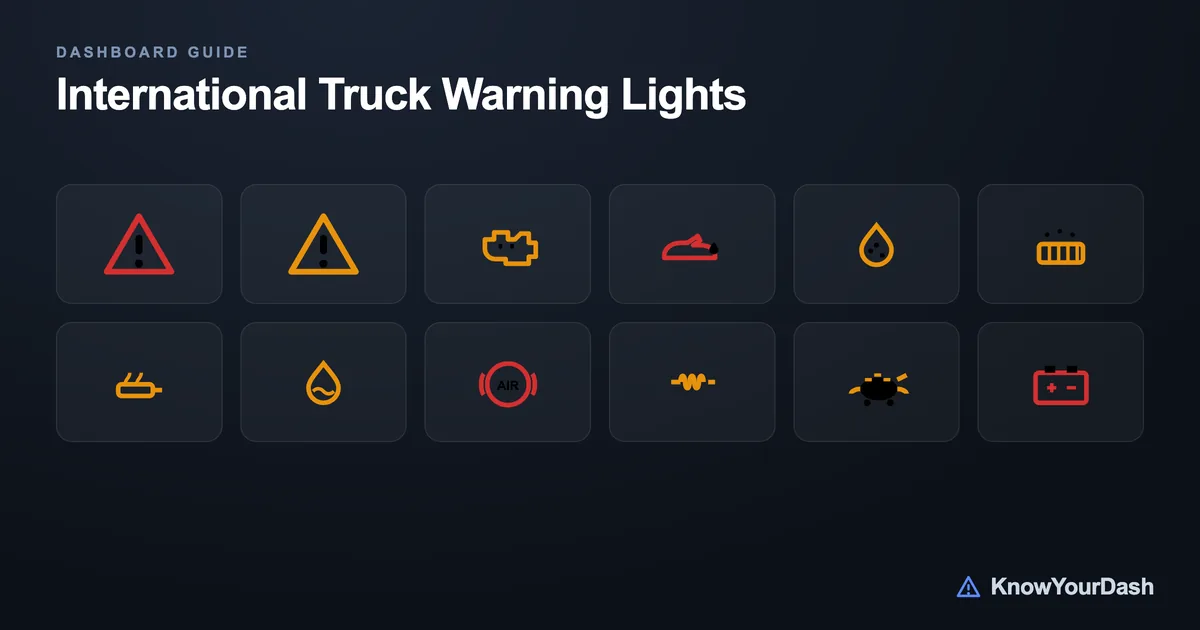
International (Navistar) trucks use a tiered warning system: red means stop now, amber means act soon, and the amber triangle is your general fault indicator pointing you to a fault code on the driver display. Most diesel-specific lights - DEF, DPF regen, HEST - are amber and give you a window to act before power is reduced or the engine protects itself.
The guide below covers the real dash lights found on the LT, HX, MV, ProStar, DuraStar, and WorkStar series running MaxxForce and Cummins/International A26 engines. Colors and exact icons can vary by model year, so keep the owner card in the cab as a backup.
International Truck Warning Lights at a Glance
The table below lists the most common dash indicators across the International heavy-truck lineup. Red lights require you to stop safely as soon as possible. Amber lights mean schedule service or act before the end of the shift. Green and blue lights confirm a system is active.
Stop Engine
Engine protection has triggered. A critical parameter - oil pressure, coolant temp, or coolant level - has reached a shutdown threshold.
What to do: Pull off the road safely and shut the engine down immediately. Do not restart until the fault is diagnosed.
Warn Engine (Amber Triangle)
The engine ECM has detected a fault that does not yet require a shutdown. The driver display will show an active fault code.
What to do: Note the fault code on the display. You can usually complete the trip, but schedule service before the next run.
Check Engine (MIL)
An emissions-related fault has been stored. Common causes include a failed sensor, DPF issue, or EGR fault.
What to do: Connect a diagnostic scanner to read the active code. The truck is usually drivable to a shop but should not be ignored.
Low Engine Oil Pressure
Oil pressure has dropped below a safe operating threshold. Continued operation risks severe engine damage within seconds.
What to do: Shut the engine down immediately. Check the oil level once the engine cools. Do not restart until pressure is confirmed.
High Coolant Temperature
Coolant temperature has exceeded the safe limit. Causes include a low coolant level, failed thermostat, or blocked radiator.
What to do: Pull over, shut down, and let the engine cool. Check the coolant level only after the engine is cold. Call for service if the level is normal.
DEF Low / DEF System Fault
Diesel exhaust fluid is low, or the DEF quality sensor has detected contaminated fluid. Running out of DEF will reduce engine power.
What to do: Refill with fresh ISO 22241-compliant DEF. If the light stays on after refilling, have the DEF quality sensor checked.
DPF Regen Required
The diesel particulate filter is accumulating soot and needs regeneration. A flashing light means regeneration is overdue.
What to do: Drive at highway speed to allow passive regen, or initiate a parked regen if the light is flashing. Continued neglect will trigger limp mode.
High Exhaust System Temp (HEST)
The exhaust aftertreatment system is at high temperature, typically during an active DPF regeneration cycle.
What to do: Keep clear of flammable materials near the exhaust. The light goes off when the regen cycle completes. No driver action needed if expected.
Water in Fuel
The fuel-water separator has detected water in the fuel system. Water in diesel can damage injectors.
What to do: Drain the fuel-water separator as soon as possible. If the light returns quickly after draining, suspect a contaminated fuel source.
Low Air Pressure
System air pressure has dropped below roughly 60 psi. At this level, spring brakes may apply automatically.
What to do: Do not release the parking brake. Allow the compressor to build pressure above 90 psi before moving. Investigate for leaks if pressure does not build.
Wait to Start / Preheat
The glow plugs are warming the combustion chambers before cold-weather starting. This is a normal cold-start sequence.
What to do: Wait until the light goes out - usually 5 to 20 seconds - before cranking. Cranking early causes hard starts and excess white smoke.
Transmission Temperature High
Transmission fluid temperature is above the normal range, often from heavy towing, grade work, or low fluid level.
What to do: Reduce load or shift to a lower gear to allow cooling. If the light stays on after the load is reduced, check the fluid level and schedule service.
Fuel Filter / Water Separator
The primary fuel filter is restricted or the separator bowl needs draining. A clogged filter starves the high-pressure pump.
What to do: Drain the separator bowl and replace the filter at the next opportunity. Running with a blocked filter can damage the CP3 or CP4 injection pump.
Battery / Charging System
The alternator is not charging the batteries, or battery voltage has fallen below a minimum threshold.
What to do: Drive directly to a service point. Electrical systems will begin failing as voltage drops. Check belt tension and alternator output.
Parking Brake Engaged
The parking brake is applied or the spring brakes are set. This light will stay on until pressure releases the spring brakes.
What to do: Confirm the trailer and tractor park brake controls are in the drive position before moving the truck.
Derate / Reduced Power
The engine management system has reduced power output to protect the engine or aftertreatment system. Caused by ignored DEF, DPF, or engine faults.
What to do: Address the underlying fault - usually DEF level or a parked regen - to restore full power. A deeper derate requires a dealer reset.
Understanding the Amber Triangle on International Trucks
The amber upside-down triangle is the most misunderstood light on the International dash. It does not point to one specific fault. Instead, it functions as a general fault indicator - the ECM's way of saying 'there is an active code; look at the driver display.' The display will scroll through active fault codes using a SPN/FMI format (Suspect Parameter Number / Failure Mode Indicator).
A triangle alone with no other active lights usually means an emissions or sensor fault that does not yet affect engine operation. When the triangle appears together with the amber Warn Engine lamp, the fault is more significant but not yet at shutdown level. When a red Stop Engine light joins the pair, the engine is about to protect itself - pull over.
Many drivers ignore a lone amber triangle for weeks. That is a mistake: most underlying faults will worsen, and the missed DPF or DEF fault will eventually trigger a derate, costing you far more downtime than a quick diagnostic scan would have.
DEF and Aftertreatment Lights: What the Progression Looks Like
International's Selective Catalytic Reduction (SCR) system uses DEF to break down NOx emissions. The dashboard reflects the health of the whole aftertreatment chain through a sequence of lights:
- DEF Low (amber): You have roughly one to two tanks of fuel left before a derate. Refill at the next stop.
- DEF Very Low (amber, flashing): Power reduction is imminent. Refill now.
- DEF Derate (amber + reduced-power light): The truck is running at a fraction of its rated power. Refill DEF and perform a parked regen to recover.
- DPF Regen Required (amber): Passive regen at highway speed may clear this. If driving in town, pull to a safe spot and run a parked regen from the dash menu.
- HEST (amber): The exhaust is hot during regen - normal. Keep clear of dry grass or anything flammable near the stack exit.
Using the wrong DEF - or water - will contaminate the system. The DEF quality sensor will flag it, and clearing that fault requires draining the tank completely and flushing the lines at a dealership.
Air Brake Lights and Cold-Start Indicators
Unlike air-brake trucks in older fleets, modern International trucks display a red low-air warning on the dash cluster at around 60 psi and activate a buzzer. At or below that pressure, spring brakes may fully apply and lock the rear wheels. The correct response is to leave the park brake set, let the air compressor build pressure, and investigate if pressure does not reach 90 psi within two to three minutes at idle.
Common causes of low air pressure include a failed governor, air dryer cartridge saturated with moisture, a leaking gladhand seal, or a ruptured air line. Check for audible leaks at the trailer connections first - that is the most common source after coupling.
The Wait-to-Start (glow plug preheat) light is the opposite of an emergency. In temperatures below about 40 degrees Fahrenheit, the system pre-heats the combustion chambers for 5 to 20 seconds. Just hold the key in the 'on' position and crank only after the light goes out. Forcing a start while the light is on leads to hard starts, excess white exhaust smoke, and unnecessary strain on starter components.
Common questions
What does the amber upside-down triangle mean on an International truck?
It is the 'Warn Engine' or general fault indicator. The ECM has detected a fault and stored a code. Check the driver information display for the active SPN/FMI code. The truck is usually drivable to a shop, but do not ignore it - most underlying faults worsen if left unaddressed.
Can I keep driving with the DPF regen light on?
A steady amber DPF light means regen is needed but not yet overdue - you have some time. A flashing DPF light means stop and do a parked regen as soon as it is safe. Keep driving through a flashing light and the engine will eventually derate to protect the filter.
Why does my International truck lose power after the DEF light comes on?
Federal emissions regulations require that SCR-equipped diesel trucks reduce power if DEF runs out or the system malfunctions. International trucks follow this derate schedule: a warning, then a mild power reduction, then a severe derate. Refilling with fresh DEF and sometimes performing a parked regen will restore power. If the derate persists after refilling, a dealer-level diagnostic reset is usually needed.
What should I do when the red Stop Engine light comes on?
Pull off the road as quickly and safely as possible and shut the engine down. Do not keep driving to 'make it to the next exit' - the light means a critical parameter (oil pressure, coolant temperature, or coolant level) has crossed a threshold where continued operation risks serious engine damage within minutes.
My International truck shows a battery warning light. Can I drive it?
Drive directly to a service point without making additional stops. A charging-system failure means the truck is running solely on battery reserve. As voltage drops, the ABS, transmission controls, and eventually the engine ECM will lose power. Most trucks give you 20 to 40 minutes of drive time - use it to get off the highway and call for help.
How do I do a parked regen on an International truck?
Park on a flat surface away from flammable materials, set the park brake, and let the engine warm to operating temperature. Find the regen option in the dash menu (location varies by year - check the driver card in the cab). The cycle takes 20 to 45 minutes. The HEST light will stay on during the process - that is normal. Do not shut the engine off mid-cycle.