
Honda CR-V Dashboard Warning Lights Explained
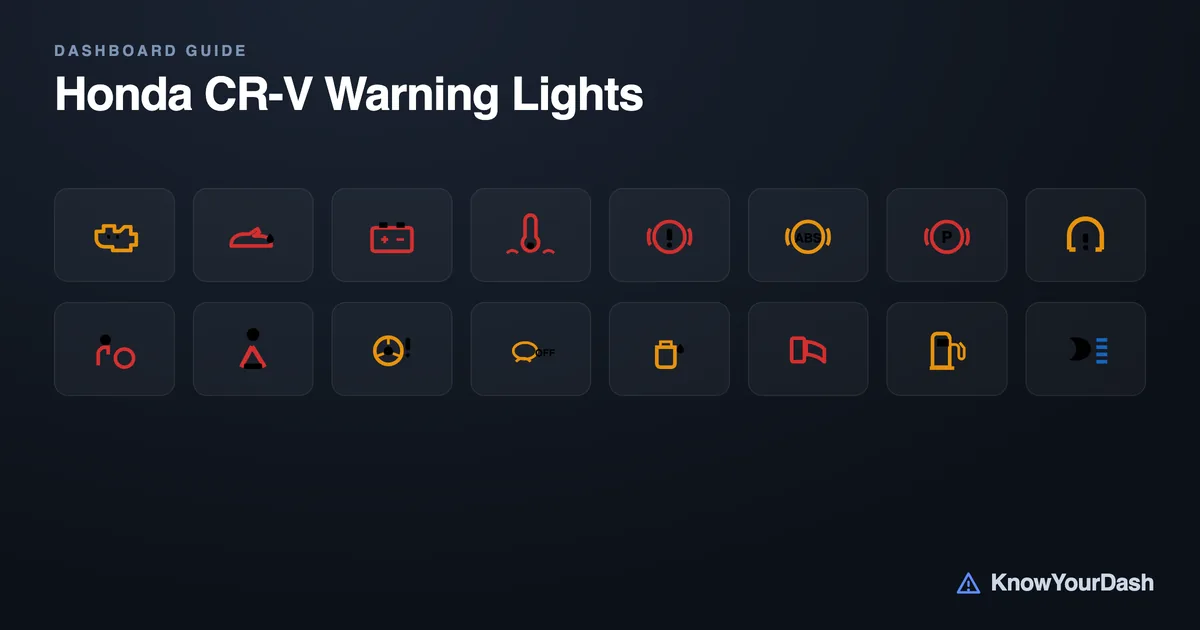
Most CR-V owners have been there: you start the car and something lights up on the dash that wasn't there yesterday. Some of those lights mean pull over right now; others are just the car nudging you toward routine maintenance. Knowing which is which saves you from unnecessary panic, and from ignoring something that actually needs attention.
Honda uses color to signal urgency. Red means serious, stop or act immediately. Amber means something needs attention soon but isn't an emergency. Green and white are just informational. That color code alone will get you a long way before you even identify the specific symbol.
Red warning lights: stop and deal with these
Red lights are Honda's way of telling you the car has a real problem right now. Don't ignore them and hope they go away. Here's what the critical ones mean.
Oil pressure (red oil can icon): This is one of the few lights that genuinely warrants pulling over immediately. Low oil pressure means your engine isn't being lubricated properly, and running it that way for even a few minutes can cause serious internal damage. Pull to a safe spot, shut off the engine, check the oil level with the dipstick. If the oil is fine and the light stays on, don't restart, call for help.
Brake system warning (red exclamation in circle): Three things can trigger this one. First, your parking brake is still on, release it and the light should go off. Second, brake fluid is low. Third, there's an actual fault in the brake system. If the parking brake is definitely released and the light is still on, check your brake fluid reservoir under the hood. If fluid is low or the light just won't go away, get it looked at before your next drive.
Battery / charging system (battery icon): The car's alternator isn't keeping the battery charged. You might have enough power to drive for a short while, but the car will eventually die. Get to a shop or at least somewhere you can have it properly diagnosed. Don't run the heat, radio, and every accessory on the way there.
The warning lights you'll see in a CR-V
These are the symbols that show up most often across CR-V generations, from the fifth-gen (2017-2022) through the current sixth-gen.
Check engine light
The engine control system has detected a fault, could be anything from a loose gas cap to an oxygen sensor or catalytic converter issue.
What to do: If it's steady and the car feels fine, check that your gas cap is tight first; if it stays on after a day or two, get it scanned for codes at a shop or auto parts store.
Oil pressure warning
Engine oil pressure has dropped below the safe threshold, which puts internal engine components at immediate risk.
What to do: Pull over safely, turn off the engine, check the oil level, if it's fine and the light is still on, do not restart and call for assistance.
Charging system warning
The alternator isn't charging the battery, so the car is running off reserve power only.
What to do: Head to a shop as soon as you can and avoid draining the battery further by turning off non-essential electronics.
Brake system warning
Either the parking brake is engaged, brake fluid is low, or there's a fault in the hydraulic brake system.
What to do: Release the parking brake and see if the light clears; if it stays on, check brake fluid and have the system inspected before driving further.
ABS warning
The anti-lock braking system has a malfunction and won't activate during hard stops or on slippery roads.
What to do: Your regular brakes still work, but you've lost the ABS safety net, drive carefully and schedule a diagnosis soon.
Tire pressure (TPMS)
One or more tires is significantly underinflated, or less often, a TPMS sensor has failed.
What to do: Check all four tires and inflate to the PSI on the door jamb sticker; if the light stays on after inflating, there may be a slow leak or a bad sensor.
Airbag / SRS warning
There's a fault in the supplemental restraint system, airbags and seatbelt pretensioners may not work in a crash.
What to do: This one needs a dealer visit as soon as possible; don't sit on it since airbag issues directly affect crash safety.
Electric power steering warning
The electric power steering system has a fault and may not be assisting you normally.
What to do: Steering will feel noticeably heavier; the car is still drivable but get it diagnosed promptly, some cases resolve after a restart, but recurring faults need proper repair.
Master warning (exclamation mark)
A general alert that something needs attention, on the CR-V it often pairs with a message on the multi-information display that tells you exactly what's wrong.
What to do: Check the MID screen for the accompanying message, which will tell you what system triggered the alert.
Low oil level
The engine oil level has dropped below the recommended minimum, distinct from the oil pressure light, this is a level warning rather than a pressure emergency.
What to do: Top off with the correct grade oil (0W-20 for most CR-V engines) at your next opportunity; don't let it go more than a day or two.
Washer fluid low
The windshield washer fluid reservoir is nearly empty.
What to do: Refill the reservoir with washer fluid, not water, which can freeze or grow bacteria in the lines.
VSA (stability control)
Vehicle Stability Assist is switched off or has found a fault. It also blinks briefly when the system is working on a slippery road, which is normal.
What to do: If it stays on steady, traction and stability help may be disabled. Have it scanned, especially if it showed up with other lights.
Low fuel
You are down to roughly the last couple of gallons.
What to do: Fill up soon. Regularly running it to empty is hard on the fuel pump.
Door or tailgate open
A door, the hood, or the power tailgate is not fully latched.
What to do: Make sure everything is shut, including the tailgate. It clears once it latches.
Amber lights: not emergencies, but don't ignore them
Yellow and amber lights usually mean schedule service soon rather than pull over immediately. The TPMS light already covered above is one of them. A few others worth knowing:
- Maintenance Minder (wrench icon): Honda's system is telling you it's time for scheduled service, oil change, tire rotation, or something else based on your driving data. The letter codes displayed alongside the wrench (A, B, 1, 2, etc.) indicate which services are due. An A1 code means oil change plus tire rotation; a B means oil change plus brake inspection, for example. You can keep driving, but book the appointment.
- VSA warning (triangle with car): The Vehicle Stability Assist system has a fault. VSA helps prevent skids and loss of control on slippery roads, so a persistent fault reduces your safety margin in bad weather. A brief flash during hard acceleration or cornering is normal, the system doing its job. A steady amber light means something's wrong with the system itself.
- Fuel low indicator: The fuel level is low, you've got roughly 2 to 3 gallons left depending on the CR-V generation. Don't consistently run the tank this low; it shortens fuel pump life over time.
A note on the Maintenance Minder system
The CR-V doesn't run on fixed oil change intervals the way older cars did. Honda's Maintenance Minder calculates service intervals based on your actual driving, trip length, temperature, engine load. When the oil life percentage drops to 15%, the wrench appears. At 5%, it gets more insistent.
The letter and number codes give you a breakdown: the main code (A or B) tells you the primary service, and the sub-codes (1-6) add items like air filter, transmission fluid, or spark plugs. Your owner's manual or a quick search on Honda's site will decode the specific combination showing on your dash. It's a genuinely useful system, don't just reset it without doing the work it's asking for.
What to do when multiple lights come on at once
If several warning lights flare up at the same time, especially the VSA, power steering, and TPMS together, the most common cause is a weak or failing battery. When voltage drops below what the car's systems need, they start throwing faults all over the place. A lot of CR-V owners have replaced sensors and had expensive diagnostics done only to find out the battery was the culprit the whole time.
The other scenario is a software glitch. Try this: with the car parked safely, turn it completely off, wait 30 seconds, restart. Some transient faults clear themselves. If the lights come back on, that's the car telling you the fault is real and persistent.
- Multiple lights all at once: suspect the battery first, especially if the car is more than 4-5 years old.
- Single light that clears and returns: could be an intermittent sensor or a developing fault that needs a code scan to pinpoint.
- Red light paired with unusual sounds, smells, or the car driving differently: don't second-guess it, pull over.
Common questions
Can I drive my Honda CR-V with the check engine light on?
It depends on what's behind it. If the light is steady and the car is running normally, no rough idle, no loss of power, no strange smells, you can usually drive it for a day or two while you arrange a diagnosis. But if the light is flashing or blinking, that signals a misfire that's actively damaging the catalytic converter, and you should stop driving and get it scanned right away. A flashing check engine light is a different beast from a steady one.
Why did my CR-V's TPMS light come on in cold weather?
Cold temperatures cause air to contract, so tire pressure drops naturally in winter, roughly 1 PSI for every 10 degrees Fahrenheit. A tire that was properly inflated at 65F can easily trigger the TPMS warning at 20F. Fill all four tires to the recommended pressure (found on the sticker inside the driver's door jamb, not the number printed on the tire sidewall) and the light should go off within a few miles of driving. Keep a pressure gauge in the car during winter months.
What does it mean when the Honda CR-V oil pressure light flickers at idle?
Occasional flickering at a hot idle, especially on older high-mileage engines, can happen when oil pressure dips slightly at low RPM. But if it's happening consistently, check the oil level first. If the level is fine, the causes could include a worn oil pump, a failing pressure sensor, or engine wear that's reduced internal tolerances. Don't dismiss it as just a sensor issue without checking the actual pressure. A mechanic can hook up a mechanical gauge to get a real reading.
My CR-V's battery light came on but the battery is new. What's wrong?
A new battery doesn't rule out a charging problem, the battery light actually monitors the charging system, not just the battery itself. The most likely culprit with a new battery is a failing alternator. Other possibilities include a loose or corroded alternator belt, a bad voltage regulator, or even a wiring fault. Have the charging system output tested, most auto parts stores will do it free. The alternator should be putting out roughly 13.5 to 14.7 volts at idle when the system is working properly.