
Freightliner Dash Warning Lights and Symbols
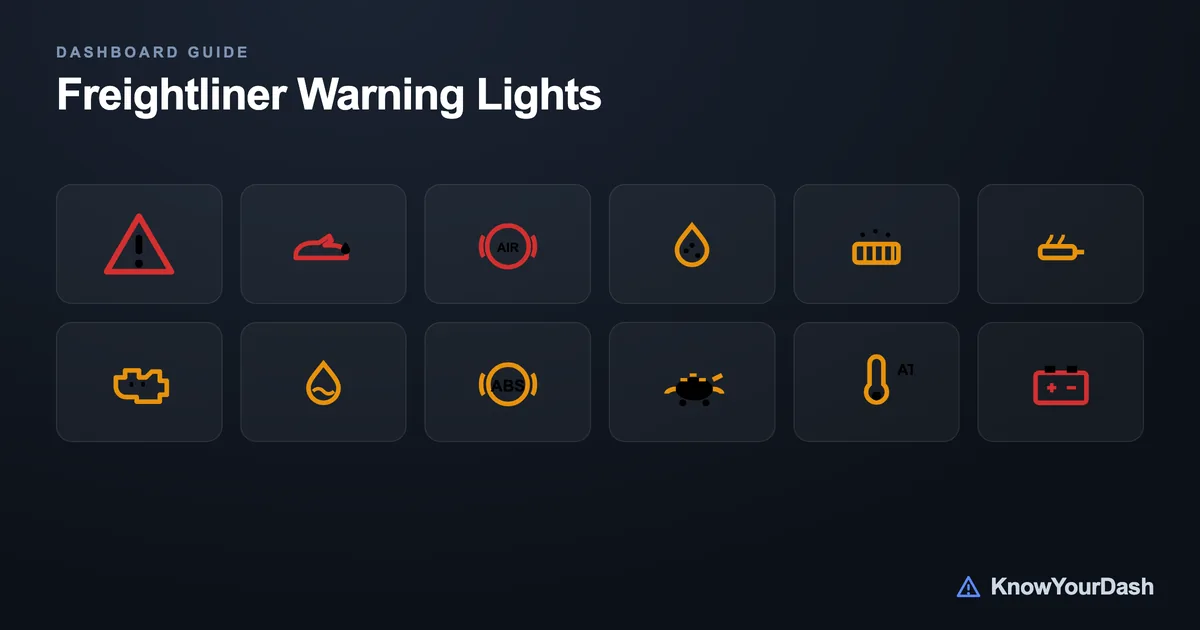
Red means stop. Amber means service soon. On a Freightliner Cascadia those two sentences cover most situations, but knowing which light is on and why is what keeps a load moving and an engine alive. The Cascadia's instrument cluster pairs colored warning lamps with a Driver Message Center (DMC) text readout, so you usually get both a symbol and a short description.
This guide covers the most common lights found on Freightliner Cascadia models powered by Detroit DD13, DD15, and DD16 engines, as well as earlier Freightliner trucks. Lights are grouped by severity - red critical warnings first, then amber cautions, then informational.
Red Warning Lights - Stop the Truck
Any red lamp on a Freightliner is a stop-now signal. These lamps indicate conditions that can destroy an engine or cause a brake failure within minutes of being ignored. Pull off the road safely, shut down, and investigate before continuing.
Stop Engine
The engine has detected a critical fault - typically catastrophic oil pressure loss, severe overheating, or a major sensor failure reported via SPN/FMI code.
What to do: Pull over immediately, shut the engine down. Do not restart until the fault code has been read and the root cause confirmed. Continuing risks seizing the engine.
Low Engine Oil Pressure
Oil pressure has dropped below the safe threshold. Causes include low oil level, a worn oil pump, a clogged pickup tube, or a failed pressure sensor.
What to do: Stop and shut off the engine at once. Check the oil level. If oil is full and pressure remains low, do not restart - have the truck towed. Running a diesel on low oil pressure causes rapid bearing damage.
High Coolant Temperature
The engine coolant has reached a dangerous temperature. Common causes include a coolant leak, failed thermostat, clogged radiator, or a faulty water pump.
What to do: Pull over and shut down. Let the engine cool before opening the coolant cap. Check the surge tank level. If coolant is low, inspect hoses for leaks before topping up and continuing.
Low Air Pressure
Primary or secondary air system pressure has dropped below roughly 60 psi. The audible buzzer will sound simultaneously. Spring brakes may apply automatically.
What to do: Pull over safely. Do not attempt to continue driving. Check for air leaks throughout the system. Common culprits on the Cascadia include a faulty air pressure switch, a leaking air dryer purge valve, or a cracked air line.
Brake System Fault
A fault has been detected in the service brake circuit. This covers brake fluid pressure loss, a hydraulic leak (on trucks with hydraulic brakes), or a foundation brake fault.
What to do: Test brake pedal feel immediately. If the pedal is soft or sinks, stop at once. Read DMC message for more detail. Do not drive until the brake system is inspected.
Emissions System Lights - DEF, DPF, and HEST
Post-2010 Freightliner trucks with Detroit engines run a full aftertreatment system - Diesel Particulate Filter (DPF), Selective Catalytic Reduction (SCR), and Diesel Exhaust Fluid (DEF). These three lights are the most common amber warnings a Cascadia driver will see. They are related: a dirty DPF forces more frequent regens, which burns through DEF faster, which raises exhaust temps.
DEF Level Low
Diesel Exhaust Fluid in the tank is running low. The SCR system needs DEF to reduce NOx emissions. The DMC will show the remaining range before a derate kicks in.
What to do: Refill DEF at the next truck stop. Ignore the first warning and the engine will derate to 65 mph, then 5 mph. DEF is widely available and costs little - do not gamble on making it to the terminal.
DPF / Regen Required
The Diesel Particulate Filter has loaded up with soot and passive regen (which happens automatically at highway speeds) has not been sufficient to clean it.
What to do: If driving at highway speed, maintain it - passive regen may complete on its own. If the light stays solid, find a safe spot and perform a parked regen per the procedure in the owner manual. A blinking DPF light means a parked regen is now required.
HEST - High Exhaust System Temp
The exhaust system is at elevated temperature, typically because a regen is in progress. A slow (10-second) flash means active regen. A steady light at low speeds means the tailpipe outlet is very hot.
What to do: Do not park near dry grass, fuel, or any flammable material while HEST is on. The light is normal during regen - you do not need to stop driving. At speeds below 5 mph with a solid HEST light, move away from anything combustible.
Amber Caution Lights - Service Soon
Amber lights on a Freightliner indicate a fault that needs attention before it becomes a red-light problem. You can typically complete your current trip, but do not defer these beyond the next scheduled stop.
Check Engine (MIL)
The engine control module has stored one or more SPN/FMI fault codes. A steady MIL is a caution; a flashing MIL indicates an active misfire or condition that can damage the DPF or aftertreatment system.
What to do: Connect a heavy-duty scanner (like a Detroit DiagnosticLink or Cummins INSITE) to read the specific SPN and FMI. A flashing MIL means reduce load and get to a shop the same day.
Water in Fuel
The fuel/water separator has detected water mixed into the fuel. Water in a diesel injection system can damage injectors and the high-pressure pump.
What to do: Drain the water separator at your next stop using the drain valve at the bottom of the filter housing. If the light comes back on after draining, replace the fuel filter and inspect the fuel tank for contamination.
ABS Fault
The Anti-lock Brake System has detected a fault, most often a failed wheel speed sensor, a damaged tone ring, or a corroded sensor connector. The truck can still stop, but ABS may not function.
What to do: Brakes work normally but ABS is disabled. Avoid hard stops that could cause wheel lockup. Have a shop read the ABS module codes. On Cascadia, corrosion at the sensor connector is a frequent cause - clean or replace the connector before replacing the sensor.
Traction/Stability Fault
The stability control or traction control system has a fault, often tied to the same wheel speed sensors used by ABS. The system may be partially or fully disabled.
What to do: Drive with extra care, especially on wet or loose surfaces. Use a diagnostic scanner to pull the active fault codes. The ABS and stability warnings often appear together when a wheel speed sensor fails.
Transmission Warning
The transmission control module (TCM) has logged a fault. On Cascadia trucks with Eaton Fuller Advantage or Allison automatics, this can mean overheating, clutch wear, solenoid issues, or a speed sensor fault.
What to do: Check the transmission fluid level and condition. Avoid hard acceleration. Pull fault codes with a compatible scanner. If the DMC shows a transmission temperature message, allow it to cool before continuing.
Fuel Filter / Water Separator
The fuel filter is nearing the end of its service life, or the water separator is full. Restricted fuel flow will eventually cause rough running and a loss of power.
What to do: Replace the primary fuel filter at your next maintenance stop. Drain the water separator first. On Cascadia, the Davco or similar separator has a clear bowl - check it visually if the light comes on.
Engine Brake / Retarder Active
The engine brake (Jake Brake) or an exhaust retarder is engaged. This is an informational indicator, not a fault.
What to do: No action needed. The light confirms the retarder is working. Some municipalities prohibit engine brakes - disengage as required by local signage.
Reduced Power / Derate
The engine has entered derate mode, limiting power or speed. Common causes are a missed DEF refill, a high DPF restriction, or a critical engine fault where the ECM allows limited operation rather than a full shutdown.
What to do: Check the DMC for the derate reason. DEF-related derates clear once the tank is refilled. Other derates require fault code diagnosis. Do not ignore a derate - the next stage may be a 5 mph creep mode.
High Engine Oil Temperature
Engine oil temperature is elevated beyond the normal operating range. Can indicate a blocked oil cooler, a heavy-load situation without sufficient cooling, or low oil level.
What to do: Reduce engine load if possible. Check oil level at the next safe stop. If the temperature does not drop back to normal within a few minutes of reducing load, park and investigate before the light turns red.
Parking Brake Applied
The parking brake (spring brakes) is fully or partially applied. On air-brake trucks, a yellow valve controls the trailer brakes and a red valve controls the tractor spring brakes.
What to do: Confirm both the red and yellow dash valves are fully in the 'out' (released) position before moving. Driving with spring brakes dragging will overheat the drums and damage the foundation brakes.
Battery / Charging System
The alternator is not maintaining adequate charge to the batteries, or battery voltage has dropped below threshold. On Cascadia, the large 12V or 24V battery banks power the ECM, DMC, and ABS module.
What to do: Check the alternator belt and connections. Test battery voltage and charging output. A Cascadia with failed charging will eventually lose the DMC and may develop electrical faults in multiple systems.
Low Engine Oil Level
The oil level sensor in the sump has detected oil below the minimum mark. Different from the oil pressure light - this is a level check, not a pressure reading.
What to do: Check the dipstick at the next stop. Add the correct grade of engine oil to bring the level to the full mark. Continued operation with low oil risks pressure loss under high load.
How the Cascadia Driver Message Center Works
The DMC is the text display built into the instrument cluster. When a warning lamp lights, the DMC shows a short message - for example 'Stop Engine Oil Pressure' or 'Regen Required.' Always read the DMC message alongside the lamp color because the same amber lamp can mean half a dozen different things depending on which system triggered it.
Many faults also generate a J1939 SPN (Suspect Parameter Number) and FMI (Failure Mode Indicator) code. These are the heavy-truck equivalent of OBD-II codes. A Detroit DiagnosticLink laptop, a Cummins INSITE tool, or a quality Bluetooth adapter paired with a heavy-duty app can read them. Standard car OBD-II readers will not work on the Cascadia's J1939 data link.
If multiple lamps light at once, address red lamps before amber ones. A single failed wheel speed sensor can trigger ABS, traction control, and hill-start assist warnings together - three lamps for one root cause.
Common questions
What does a solid red stop engine light mean on a Freightliner Cascadia?
A solid red stop engine light means the engine control module has detected a condition severe enough to risk engine damage if you keep running - most often critically low oil pressure or a major sensor failure. Pull over safely and shut the engine down. Read the DMC text message for more detail and pull fault codes with a heavy-duty scanner before deciding whether to restart.
Why does my Freightliner keep showing a low air pressure warning even though the tanks are full?
A false low air pressure warning on the Cascadia is usually caused by a faulty air pressure switch on the primary tank, a leaking air dryer purge valve that bleeds air slowly, or corroded wiring to the pressure sensor. Test the switch with a multimeter. If the switch checks out, listen for the purge valve cycling when it should not be. Replace whichever component is at fault - the switch itself is an inexpensive part.
How long can I drive with the DEF warning light on?
Not long. The Cascadia's DEF derate system works in stages: a first warning at around 10-15% DEF remaining, a 65 mph speed cap at roughly 5%, and a 5 mph creep mode shortly after. The exact mileage depends on duty cycle, but do not plan on more than 50-100 miles from the first warning to a potential 5 mph derate. Refill DEF at the next truck stop and the derate clears on its own.
My DPF light is flashing - can I keep driving?
A flashing DPF light on the Cascadia means a parked regen is now required. You can drive to a safe location to perform the regen, but do not keep logging miles hoping it will clear. A parked regen takes 20-40 minutes and requires the truck to be stationary in neutral with the parking brake set. Follow the procedure in your driver manual. Ignoring the flashing light long enough will result in a derate and eventually a solid red lamp.
Can I reset Freightliner warning lights without a scanner?
Some informational lamps (like the HEST light after a regen completes) clear on their own once the condition resolves. Most fault-triggered amber and red lamps will not clear just by cycling the ignition - the underlying fault code stays stored in the ECM until it is read and cleared with a heavy-duty diagnostic tool. A standard OBD-II Bluetooth reader will not communicate with a Cascadia's J1939 system.
What is the difference between the ABS light and the traction control light on a Freightliner?
The ABS light signals a fault in the anti-lock brake modulator circuit - often a failed wheel speed sensor. The traction and stability control lights mean those systems cannot operate, usually because they depend on the same wheel speed sensors as ABS. When one sensor fails, all three lights commonly appear together. Fix the root cause - typically the sensor or its corroded connector - and all three lamps clear at once.