
Kia Exclamation Point in Triangle: What That Warning Light Means
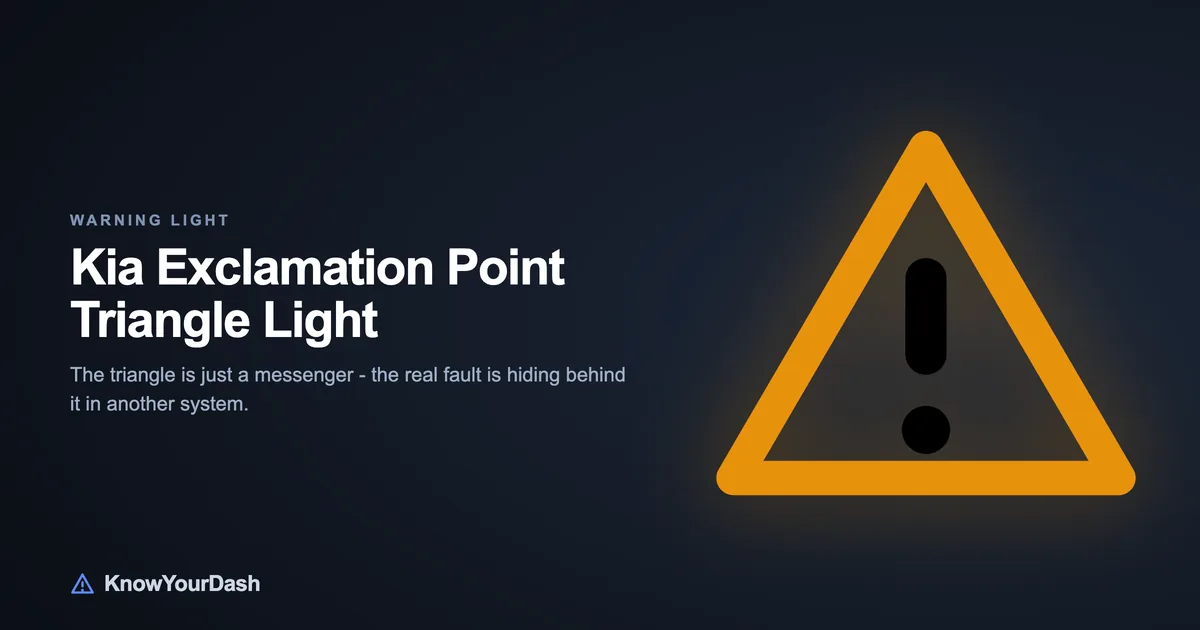
The amber or red triangle with an exclamation point on your Kia dashboard is the master warning light. It does not name a single fault on its own - it signals that one or more secondary systems on your car have flagged a problem and want your attention.
On most modern Kia models, the triangle lights up alongside a text message in the instrument cluster display or a second warning symbol. That companion message is where the actual cause is spelled out. Knowing which system triggered the master warning tells you whether you can keep driving or need to pull over right away.
What the triangle with exclamation point actually does
Kia uses the exclamation-point-in-triangle as a catch-all alert. The car's body control module monitors a range of non-critical and semi-critical systems. When any of them report an issue, the master warning triangle activates on the dash to grab your attention.
The triangle by itself tells you almost nothing about the specific problem. The real information comes from two places: a short text message that appears in the driver information display (words like 'Check Tire Pressure' or 'Washer Fluid Low'), and often a second dedicated warning icon that appears at the same time.
If more than one system faults simultaneously, the cluster may cycle through each message in sequence or show the most urgent one first. Scanning through the display using the steering wheel controls will reveal all active messages.
Amber triangle vs. red triangle - the color matters
The color of the triangle tells you how urgently you need to act.
- Amber (yellow) triangle - a caution alert. Something needs attention soon, but the car is generally safe to drive a short distance to check the issue or reach a service center. Common amber triggers include low tire pressure, low washer fluid, and a loose fuel cap.
- Red triangle - a stop alert. This version of the master warning is paired with a serious fault such as a brake system failure, low brake fluid, or a hill-start assist malfunction. Pull over as soon as it is safe to do so and do not continue driving until the cause is confirmed.
Some Kia models use only the amber variant and rely on a separate dedicated red warning icon (for brakes, for example) to indicate severity. Check your owner's manual for the exact behavior on your specific model year.
Common systems that trigger this light
These are the faults most frequently paired with the Kia master warning triangle:
Tire Pressure (TPMS)
One or more tires are significantly under-inflated, or the TPMS sensor has malfunctioned (shown by a flashing light at startup).
What to do: Check all four tire pressures with a gauge and inflate to the door-jamb spec. A flashing TPMS light at startup means the sensor system itself needs diagnosis.
Brake System Warning
Brake fluid is low, or a fault has been detected in the hydraulic brake system or electronic brake-force distribution.
What to do: Stop driving. Check brake fluid level first. If fluid is correct and the light remains, have the car towed to a workshop - do not drive with a suspected brake fault.
Hill-Start Assist / HAC
The hill-start assist control system has detected a malfunction and is disabled.
What to do: The car can still be driven, but be careful on inclines. Schedule a scan with a Kia-compatible OBD tool or dealer to retrieve the stored fault code.
Washer Fluid Low
The windscreen washer reservoir is nearly empty.
What to do: Refill the washer reservoir with the correct fluid. The light goes off automatically once the sensor detects sufficient fluid level.
How to find the real cause quickly
Follow these steps whenever the triangle appears:
- Read the cluster display. Look at the instrument panel for any text message or a second warning symbol. That companion indicator names the faulty system.
- Scroll through active messages. Use the OK or Mode button on the steering wheel to cycle through all current alerts - there may be more than one.
- Do a quick visual check. Inspect tire pressure (visually low tire or dashboard readout), check that the fuel cap is closed tight, and peek at the washer fluid reservoir if accessible.
- Scan for fault codes. If the display gives no clear message or the light returns after you address the obvious items, plug an OBD-II scanner into the port under the dashboard (usually below the steering column). Kia's systems store codes for most master-warning triggers, including TPMS sensor faults and brake module errors.
If the triangle is red, skip straight to pulling over safely. Do not try to diagnose while moving.
Common questions
Can I keep driving when the Kia exclamation point triangle is on?
It depends on the color. An amber triangle usually means a non-emergency issue like low tire pressure or low washer fluid, so short-distance driving while you investigate is generally acceptable. A red triangle is a stop signal - pull over as soon as it is safe and do not continue until you know what caused it.
Why does the triangle light come on but no other warning is visible?
Some faults only store a fault code without flashing a second dedicated icon. In that case, the cluster display text message is your only clue. If even that is absent, use an OBD-II scanner to read the stored codes - the fault is logged even when the display has returned to normal.
My Kia triangle light came on after a tire rotation. Why?
Tire rotations can confuse the TPMS system because the sensor positions no longer match what the car expects. You may need to reset the TPMS by driving at highway speed for several miles, or by using the TPMS reset button (some models have one) or an OBD scanner. The master warning triangle will clear once the system re-learns the sensor positions.
Does the Kia exclamation triangle mean the check engine light?
No. The check engine light on a Kia is a separate symbol - it looks like an engine outline or reads 'Check Engine' on the display. The exclamation-point triangle is the master caution indicator for body and safety systems such as tires, brakes, and fluid levels. Both can appear at the same time if multiple faults exist.