
Chrysler Pacifica Auto Start-Stop Warning Light: What It Means
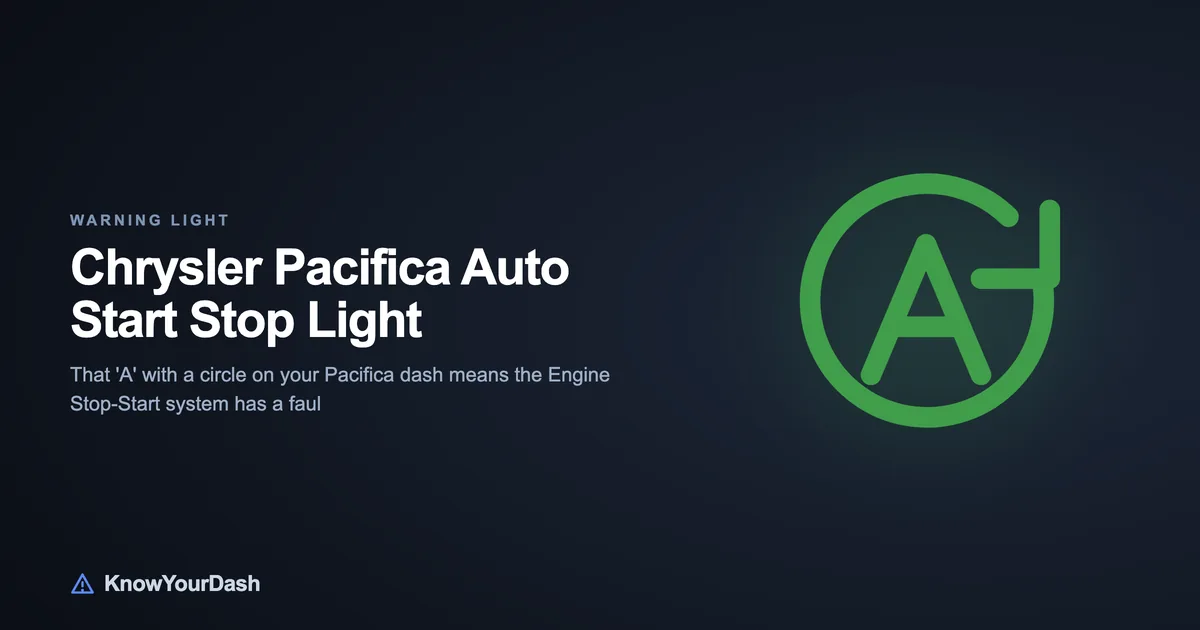
The auto start-stop warning light on a Chrysler Pacifica is a yellow or amber 'A' symbol with a circular arrow around it. When it stays on, it means the ESS (Engine Stop-Start) system has detected a problem and disabled itself - the engine will no longer shut off automatically at red lights until the fault is cleared.
The most common cause by far is a weak or failed auxiliary battery. The Pacifica runs two batteries: a main AGM battery and a smaller auxiliary battery dedicated to the stop-start system. When the auxiliary battery drops below the threshold the system needs, that warning light comes on and ESS stops working. The fix is almost always a battery replacement, not a major mechanical repair.
What the symbol looks like and what it tells you
The ESS indicator is a letter 'A' inside a circle of arrows - it looks like a recycling symbol with an 'A' in the middle. Under normal operation, this same symbol glows green when the engine is idling stopped at a light, confirming ESS shut the engine off to save fuel. When it turns amber and stays on after you start the van, it means a fault has been stored and the system has locked itself out.
Pressing the ESS disable button on the dash (same icon, usually next to the traction control) is a separate action - that button tells ESS to stay off for this drive. The warning light is different: it means the system itself has a problem and cannot run at all, even if you wanted it to.
Auto Stop-Start (ESS) Warning
The Engine Stop-Start system has detected a fault and disabled itself. The van still drives normally but will not shut the engine off at stops.
What to do: Check both the main and auxiliary battery health. Have them load-tested at an auto parts store or dealer. Replace whichever battery fails the test.
The two-battery system - why it matters
Most cars have one battery. The Pacifica has two. The main battery (a Group H6 AGM unit under the hood or in the cargo area depending on year) handles starting the engine and powering the electrical system. The auxiliary battery - a smaller unit, typically an 'Aux-14' AGM - powers the electrical accessories (radio, HVAC fan, lights) during the brief moment the engine is off at a stop. Without that auxiliary battery holding voltage steady, the dash would go dark every time ESS cut the engine. The system monitors both batteries constantly and disables ESS the moment either one falls below the required charge or health threshold.
The auxiliary battery is the more likely culprit because it is smaller, cycles more frequently, and most owners do not even know it exists - so it often goes three or four years without anyone checking it. Short-trip driving makes things worse: if the van never gets a long highway run, neither battery fully recharges between trips.
Other causes worth checking
If both batteries test healthy, there are a handful of other known causes:
- Hood latch switch fault - On 2018 and 2019 Pacificas in particular, a faulty hood latch switch can falsely signal that the hood is open. ESS will not run with an open hood, so it disables and sets the warning. Replacing the hood latch switch (a relatively inexpensive part) clears it.
- IBS (Intelligent Battery Sensor) fault - The IBS on the negative terminal of the main battery monitors charge state. A failed sensor sends bad data and the system shuts down. A dealer scan will flag this quickly.
- Software / PCM calibration - A small number of owners find the light returns after a correct battery replacement until the dealer flashes an updated PCM calibration. This is more common on early 2017-2018 models.
- Extreme temperatures - ESS normally suppresses itself in very cold or very hot conditions, but under those conditions it just disables quietly without a warning light. A persistent warning light in mild weather points to a real fault, not a temperature suppression.
If you recently had any work done near the battery or under the hood, double-check that all battery cables are fully seated and corrosion-free. A loose negative cable on the auxiliary battery is a surprisingly common cause after DIY oil changes and filter swaps. For related electrical fault reading on other Chrysler products, see the Dodge ETC warning light article for how Chrysler uses similar fault-display logic across its lineup.
How to fix and reset the warning light
Start with a battery test, not a replacement. Take the van to any auto parts store - most test batteries free of charge. Ask them to test both the main and the auxiliary battery. The auxiliary is the small black unit usually mounted in the engine bay near the firewall (location varies by model year - check your owner's manual).
When you replace either battery, use only AGM-type batteries. Installing a standard flooded battery in a stop-start vehicle will cause the system to fail again quickly. The correct specs are a Group H6 AGM for the main battery and a compatible AGM Aux-14 for the auxiliary.
After replacement, perform this relearn sequence:
- With both new batteries installed, start the engine and let it warm to full operating temperature.
- Shut the engine off and leave the van sitting for at least four hours (overnight is ideal). This allows the IBS sensor to recalibrate to the new battery.
- On the next start, take a 15-20 minute highway drive. ESS should re-engage and the warning light should go out once the system confirms both batteries are healthy.
If the light does not clear after the drive, connect a scan tool to read the stored fault code. Codes in the 'Body Control Module' or 'PCM' pointing to battery voltage or IBS sensor faults will direct the next step. A dealer with a StarScan tool can also run the 'Battery Reset' procedure that forces a full IBS relearn in software.
For a broader look at clearing dashboard lights after a repair, the how to reset dashboard lights guide walks through the general process for Chrysler and other brands.
Can you drive with the warning light on?
Yes. The amber ESS warning does not indicate an engine, transmission, or safety system fault. The van will start, drive, and stop exactly as it always has - ESS simply will not shut the engine off at red lights. You lose the fuel economy benefit of the stop-start system, but the van is not at risk of breaking down because of this light alone.
That said, if the auxiliary battery has completely failed, it can occasionally cause other electrical oddities - brief voltage dips, radio resets, or HVAC glitches - because the main battery now has to cover everything during stops. So address it within a few weeks rather than ignoring it. Also note that if the main battery is the failing one, your broader charging system warning (the standard battery icon) may also appear - at that point, treat it as urgent. If you own a Chrysler minivan and are curious about the gas cap warning light that sometimes appears alongside electrical gremlins, the Chrysler gas cap warning light article covers that separate indicator.
Common questions
Is it safe to keep driving with the auto start-stop warning light on?
Yes, short-term. The van drives normally - ESS is just disabled. Plan to have both batteries tested within a few weeks. If the main battery light (the battery icon) also comes on, treat that as urgent and get it checked the same day.
Can I just disconnect the auxiliary battery to clear the light?
No. Disconnecting a failed aux battery does not reset the fault - it just removes a component the system is monitoring. The ESS module will still detect the missing battery and keep the warning on. You need to replace it with a working AGM unit and run the relearn procedure.
Why does the warning light come back after I replaced the battery?
Two common reasons: the IBS sensor has not recalibrated yet (the four-hour soak and highway drive usually fixes this), or the PCM needs a software update from the dealer to recognise the new battery correctly. A dealer scan with StarScan can force a battery reset and push any pending calibrations.
Does the Chrysler Pacifica Hybrid have the same warning light?
The plug-in hybrid Pacifica (PHEV) uses a different charging architecture and does not have the same conventional ESS system. Its battery warnings relate to the high-voltage pack and are handled differently. The amber ESS 'A' light described here applies to the standard gasoline-engine Pacifica with the conventional stop-start system.
How long does the auxiliary battery usually last?
Most owners report two to three years before the aux battery fails and triggers the light. Short-trip driving shortens its life because the battery never fully recharges. If you do mostly city driving, plan to have it tested around the two-year mark rather than waiting for the light to appear.