
Massey Ferguson Dashboard Warning Lights: What Each Symbol Means
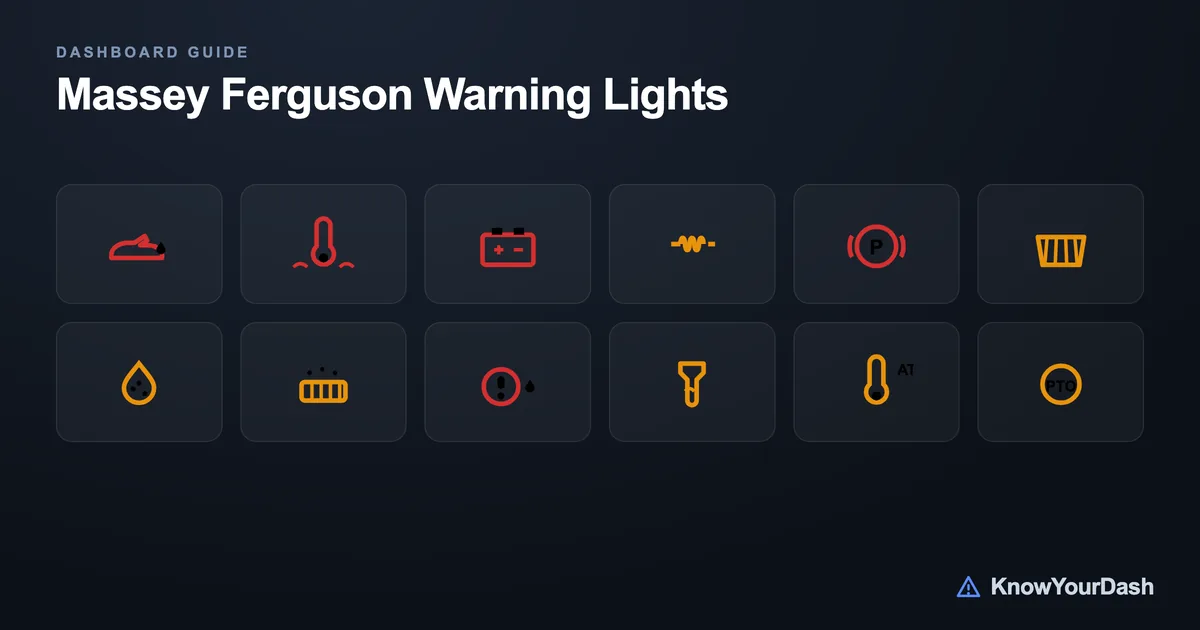
Massey Ferguson tractors use a color-coded warning system that mirrors most modern farm equipment: red lights demand an immediate stop, amber lights mean you have a service issue to address soon, and green lights confirm a system is active and running. Knowing which color you are looking at cuts the decision time in half when something lights up mid-field.
The lights below cover the MF 4700, 5700, 6700, 7700, and 8700 series as well as older models that share the same AGCO-common instrumentation cluster. Specific model years may show slight variations in symbol shape, so cross-check your operator's manual if a light looks different on your machine. For a broader look at how tractor warning colors compare across brands, the tractor dashboard symbols guide covers the general conventions used across all major makes.
Color code quick reference
Before going through each light individually, it helps to understand the three-color system MF uses across its lineup:
- Red - Critical fault or dangerously low level. Shut the engine down safely and investigate before restarting. Ignoring a red light risks catastrophic engine, hydraulic, or brake damage.
- Amber (yellow) - A fault or service need that is not immediately catastrophic but needs attention. You can usually finish the row or the headland, but do not work a full day and ignore it.
- Green - Confirmation that a driver-selected system is active. A PTO or 4WD green light should be on when that system is engaged. If the light does not come on when you engage the system, that is itself a fault.
- Blue - Informational only, typically the high-beam indicator.
Warning lights and what each one means
The lights below are the most common indicators on MF series tractors. Each row shows the symbol, its color, what it is telling you, and the first action to take.
Engine Oil Pressure Warning
Engine oil pressure has dropped below the safe operating minimum. This is a stop-immediately light.
What to do: Stop the engine at once. Check the oil level and look for visible leaks. Do not restart until you know the cause - running on low oil pressure for even a few minutes can destroy bearings and crankshaft journals.
High Coolant Temperature
The coolant is overheating. Continued operation risks head gasket failure, warped cylinder head, or seized pistons.
What to do: Stop the engine and let it cool. Check coolant level (only when cold), inspect the radiator for blockage (chaff packs the core quickly in harvest conditions), check that the fan belt is intact and the thermostat is opening.
Battery / Charging System
The alternator is not charging the battery, or battery voltage has fallen below the minimum the system needs.
What to do: Check the fan/alternator belt tension first - this is the most common cause. Also check alternator connections and battery terminals for corrosion. A failing alternator will leave you stranded; get it tested the same day.
Glow Plug / Preheat
The glow plugs are heating before a cold start. This light coming on at startup is completely normal.
What to do: Wait until the light goes out (typically 5-20 seconds depending on temperature) before cranking. Cranking while the glow plug light is still on in very cold weather leads to hard starts and excessive white smoke.
Parking Brake
The parking brake is applied, or the brake system has detected a fault. When moving, this light should not be on.
What to do: If you intend to move - confirm the parking brake is fully released. If the light stays on after release, there may be a brake pressure fault or a switch problem. Have the brakes inspected before working on slopes.
Brake System Fault
A problem has been detected in the brake circuit - low brake fluid, a pressure fault, or a sensor failure.
What to do: Stop work and check brake fluid level. If fluid is fine, have the system pressure-tested. Do not operate on hillsides or with heavy trailers until the fault is diagnosed.
Air Filter Restriction
The air filter is clogged enough to restrict airflow. The engine is working harder than it should and power may be down.
What to do: Service the primary and secondary air filter elements. In dusty conditions or when running in standing crops, MF recommends checking the filter restriction indicator every 8-10 hours rather than waiting for the dash light.
DEF / AdBlue Level or System
DEF (Diesel Exhaust Fluid, also called AdBlue) level is low, or the SCR (Selective Catalytic Reduction) emissions system has detected a fault. Present on Tier 4 Final engines (roughly 2014 onward).
What to do: Top up the DEF tank with fresh, sealed DEF fluid. If the light stays on after refilling, there may be a dosing pump or NOx sensor fault that requires dealer diagnostics. Running the DEF tank empty on Tier 4 tractors will cause the engine to derate to a low-power limp mode.
DPF / Particulate Filter Regeneration
The diesel particulate filter needs to regenerate (burn off accumulated soot). Passive regeneration happens automatically during normal high-load work; this light means active regen is needed.
What to do: If you can, continue at a moderate to high load - active regen often completes on its own. If the light flashes or a second, more urgent level lights up, the filter may need a stationary forced regen using the dash menu. Repeated regen failures should be investigated by a dealer.
Hydraulic System Warning
Hydraulic oil pressure or temperature is outside normal range, or the hydraulic filter needs service.
What to do: Check the hydraulic oil level and inspect for leaks around the hitch, remote valve couplers, and pump housing. An overheating hydraulic system (often accompanied by sluggish hitch response) usually points to low oil, a blocked filter, or excessive load on a hot day.
Fuel Filter / Water Separator
Water has accumulated in the fuel filter/water separator bowl, or the fuel filter is blocked and needs replacement.
What to do: Drain the water separator bowl - there is usually a drain plug or tap at the bottom. If water appears regularly, check that you are using clean, dry fuel and that condensation is not entering the tank. A clogged filter element will need replacement and can cause rough running and power loss.
Transmission Temperature
The transmission oil temperature is too high. Common on CVT (Dyna-VT) or Powershift models during heavy draft work in hot conditions.
What to do: Reduce the load or drop speed slightly to allow the transmission to cool. Check oil level in the transmission/rear axle housing. Persistent overheating despite reduced load points to a contaminated oil cooler or a failing temperature sensor.
PTO Engaged
The power take-off is active and turning. This is a confirmation light, not a warning - it simply tells you the PTO shaft is live.
What to do: This light should be on whenever the PTO is engaged. If you have disengaged the PTO but the light stays on, the PTO clutch or engagement switch may have failed - keep bystanders clear of the rear of the tractor until confirmed safe.
Low Engine Oil Level
Engine oil level has dropped below the minimum mark. Different from the oil pressure warning - this is a level sensor, not a pressure sensor.
What to do: Add the correct grade of engine oil before continuing work. Check for leaks or unusual consumption. If oil level drops frequently, have the engine inspected for a worn valve stem seal or piston rings.
Master Warning / Stop Light
A critical fault has been detected. On newer MF models with a colour display, this light appears alongside a fault code or text message that specifies the exact problem.
What to do: Stop safely, read the accompanying display message or fault code, and follow the instructions shown. Never operate the tractor with an active master warning light until the cause is identified.
Red lights: stop now, no exceptions
The oil pressure and high coolant temperature lights are the two that cause the most expensive damage when ignored. Both share the same logic: the fault develops quickly (oil can drain from a burst line in seconds, coolant can boil off in minutes), and the engine tolerates almost no runtime once those thresholds are crossed.
MF tractors in the 7700 and 8700 series also have an automatic engine shutdown feature that activates if oil pressure falls critically low - the tractor will cut the engine to prevent catastrophic failure. If your tractor shuts off on its own, treat it as a red-light event and investigate fully before restarting.
The master warning light (a red triangle with an exclamation mark on most models) appears whenever the on-board diagnostics have logged a fault code. On tractors with a display terminal, the code and a brief description appear alongside it. Writing that code down before clearing it is worth the extra ten seconds - some faults are intermittent and the code is the only record you have. For comparison with how Kubota handles similar red-light decisions, the Kubota tractor warning lights article walks through that brand's approach.
Amber lights: finish the row, then deal with it
Most amber lights on an MF tractor fall into one of two buckets: service items (air filter, fuel filter, DPF regen) and system faults (battery charging, hydraulic temperature, DEF). Service items are generally low-urgency within reason - the air filter light means you need to service the filter element today or tomorrow, not that you should climb off the tractor in the middle of a row. System faults need more attention: a charging system fault that is ignored for a full day's work can leave you with a dead battery and no way to start the next morning.
The glow plug light is worth singling out because new operators sometimes mistake it for a fault. It is not - it is a startup sequence indicator. On cold mornings it lights for 10-20 seconds, then goes out to signal that the pre-heat cycle is complete and the engine is ready to crank. Cranking before it goes out in sub-zero conditions is a common cause of hard starting on older MF engines with worn glow plugs.
PTO and 4WD engagement lights
Green lights on an MF tractor are confirmation indicators, not warnings. The PTO light tells you the shaft is turning. The 4WD light (where fitted) tells you front-wheel drive is engaged. A diff lock light confirms the differential is locked.
These matter for safety as much as awareness. A PTO light that stays on after disengagement means the PTO clutch or switch has failed and the shaft may still be turning - a serious hazard if anyone approaches the rear of the tractor. A 4WD light that does not illuminate when you engage 4WD suggests a solenoid, switch, or mechanical issue with the front axle drive.
MF tractors with a PTO offer multiple speeds depending on the model: 540 rpm, 540E (economy, a lower engine speed for lighter implements), and 1000 rpm. Each engagement position may show a different indicator or the same PTO symbol with a speed readout on the terminal - check your specific model's operator's manual for the exact layout. For how John Deere handles similar PTO and engagement indicators, see the John Deere tractor dashboard warning lights guide.
DEF and DPF lights on Tier 4 engines
MF tractors built after approximately 2014 (when Tier 4 Final emissions rules took effect) have two emissions-related lights that earlier models do not: the DEF/AdBlue indicator and the DPF regen indicator. Both can be unfamiliar to operators moving from older equipment.
The DEF light has a graduated warning system. A solid amber light means the DEF tank is getting low (typically below 10%). A flashing amber light means it is critically low. If the tank runs completely dry and the engine is restarted, Tier 4 tractors are legally required to derate to a low-power mode until fluid is added and the system confirms operation. Carry a spare 10-litre jug on the tractor during long days away from the yard.
The DPF regen light works differently. During normal high-load field work (plowing, heavy tillage), the exhaust gets hot enough to burn the soot off the filter passively - you may never see the regen light in demanding applications. Lighter work (mowing, spraying, road transport at low throttle) does not generate enough heat for passive regen, so the light will appear more frequently. A stationary forced regen using the dash menu takes about 30-40 minutes and should be done in an open area away from flammable materials. For comparison with similar systems on Case equipment, the Case warning lights guide explains how the same Tier 4 systems appear on Case machinery.
Common questions
What does a red warning light on a Massey Ferguson mean?
Red means stop the engine safely as soon as you can - do not finish the row. Red lights indicate a critical fault such as low oil pressure or overheating that will cause serious engine or mechanical damage if ignored even briefly.
The glow plug light stays on for a long time before starting - is that a fault?
Not necessarily. Glow plugs heat faster in warm weather (5-8 seconds) and slower in cold weather (up to 20-25 seconds on older engines). If it stays on for significantly longer than usual in moderate temperatures, one or more glow plugs may be failing and drawing extra current - worth testing.
Can I keep working when the DPF regen light comes on?
Yes, for a while. A first-level regen light means the filter is filling up and the system wants to clean it. If you are doing high-load work, increasing engine speed often lets the exhaust temperature complete the regen on its own within 20-30 minutes. If the light escalates to a flashing or more urgent warning, park and run a stationary forced regen.
My MF tractor's warning lights all came on at startup and then went off - is that normal?
Yes, that is a bulb check (also called a lamp test). When you turn the key to the 'on' position before cranking, the tractor briefly illuminates all warning lights to confirm they are working. They should all go out within a few seconds of the engine starting.
The hydraulic warning light came on but the oil level is fine - what else could cause it?
A few possibilities: a clogged hydraulic filter element (separate from the oil level), a faulty hydraulic temperature sensor reading high, a restriction in the hydraulic circuit from a kinked or collapsed hose, or an overloaded hydraulic pump from running too many implements simultaneously. Check the filter element first - it is the most common cause when oil level is confirmed normal.
How do I read fault codes on a Massey Ferguson tractor?
On older models without a display terminal, fault codes are read by a dealer using AGCO's diagnostic software (AGCO EDT). On newer MF tractors with the Datatronic 5 or similar colour terminal, active and stored fault codes appear in the diagnostics menu under 'Fault Codes' or a similar path depending on firmware version. Writing down any code before clearing it is important - the code identifies which control module is reporting the fault and saves diagnostic time later.